
A new wave of diplomatic tension has swept across the global stage this week, as Germany publicly urged U.S. President Donald Trump to reverse his dramatic decision to exclude South Africa from the 2026 G20 Summit in Florida. The statement from Berlin marks the strongest public support yet from a major Western nation after Trump escalated his attacks on Pretoria with accusations based on widely discredited claims.
This comes only weeks after South Africa hosted one of the most successful G20 summits in Johannesburg, a summit that Washington boycotted.
The question many are asking now is simple:
Is the G20 heading toward a historic split?
Let’s break down everything that happened, what Germany said, and what it all means for South Africa and global politics.
Trump Escalates His Attacks, and Excludes South Africa
Since returning to office in January, Trump has repeatedly accused South Africa’s government of persecuting white citizens, especially white farmers. These accusations mirror long-debunked conspiracy theories that have circulated for years online — often amplified by Trump’s South African–born ally, Elon Musk.
In May, Trump confronted President Cyril Ramaphosa at the White House with these claims, citing discredited stories of “white genocide.” South African officials described the meeting as tense and unproductive.
Then, in early November, the U.S. confirmed it would boycott the G20 Leaders’ Summit in Johannesburg, accusing South Africa of “human rights abuses” — a claim no other G20 member supported.
After South Africa hosted the event successfully and handed over the G20 presidency to the U.S. Embassy, Trump responded with fury.
In a Truth Social post, he wrote:
“South Africa has demonstrated they are not a country worthy of membership anywhere.”
He then announced that South Africa will not be invited to the 2026 G20 Summit in Miami.
It was an unprecedented statement — but global reaction was immediate.
Germany Pushes Back: “South Africa Must Be Invited”
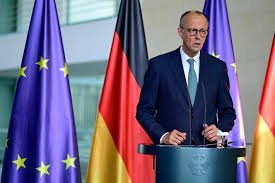
At a press conference in Berlin, German Chancellor Friedrich Merz delivered a clear message:
“The G7 and G20 are formats that should not be made smaller without good reason.
I will try to convince President Trump to invite the South African government.”
This is the first time a major Western leader has openly challenged Trump’s decision.
Merz argued that:
- South Africa is a founding member of the G20
- Global cooperation requires inclusivity
- No single nation should undermine consensus-based institutions
Germany’s intervention is significant. Historically, Berlin has been one of the most vocal defenders of multilateralism and global economic cooperation. It also has strong ties with South Africa in trade, renewable energy, and industrial investment.
Germany’s stance signals that Trump’s unilateral approach is not shared by other Western powers.
Private Support From Other G20 Members
South Africa has quietly confirmed that many G20 nations sent private messages of support, although none were named.
Ramaphosa’s spokesperson, Vincent Magwenya, told Reuters:
“A lot of G20 members have expressed support privately.”
This suggests that many countries disagree with Trump but are reluctant to challenge him openly — likely to avoid damaging bilateral relationships.
Magwenya also emphasized that South Africa:
- Will not lobby other nations for support
- Will not engage in a campaign to counter Trump’s statements
- Will continue to participate in G20 structures
South Africa says it refuses to “beg” for a place it already earned.
Could Trump Actually Block South Africa from Attending?
Technically, the U.S. hosts the 2026 summit, but it does not control G20 membership.
The G20 is a consensus-based group, and South Africa is a founding member.
No mechanism exists to expel or uninvite a member state.
However, experts warn that the U.S. could use a different tactic:
Denying South African officials entry visas.
If key ministers or diplomats are prevented from entering the U.S., they cannot attend the summit, effectively excluding the country without breaking any formal rules.
Sikho Luthango, a researcher at Cambridge University, explained:
“The U.S. could simply deny visas to South African officials.”
This highlights how vulnerable global institutions can be when host countries use immigration control as a political weapon.
A Diplomatic Standoff With Economic Consequences
The tension between the U.S. and South Africa is not happening in isolation.
1. Trade negotiations are already strained
The U.S. recently imposed a 30% tariff on South African imports — one of the highest in Africa.
2. Financial assistance was cut
In February, Trump signed an executive order slashing U.S. aid to South Africa, including funding for HIV/AIDS programs.
3. U.S.–South Africa relations are at their lowest point in decades
Between the boycott, tariffs, public attacks, and the G20 dispute, this could become one of the defining diplomatic crises of the decade.
South Africa’s Response: Defiant and Diplomatic
Ramaphosa’s office issued a firm statement:
“South Africa does not appreciate insults from another country about its worth in participating in global platforms.”
But Pretoria also made its position clear:
- It will not lobby G20 members
- It will continue to participate in the group
- It will not retaliate through insults or hostility
South Africa insists it will remain committed to multilateralism.
What Happens Next?
Germany’s intervention changes the global dynamic.
If more Western countries publicly support South Africa, Trump may face international pressure to reverse course — especially if the G7 (a group the U.S. highly values) expresses concern.
On the other hand:
- If the U.S. moves to block visas
- And other nations stay silent
- South Africa could face practical exclusion
The next few months will be critical.
But the biggest question remains:
Will the world allow one country to undermine the G20 consensus model?
Follow Yekare History for Clear Global Analysis
At Yekare History, we break down world events with clarity, accuracy, and storytelling that connects the past to the present.
????️ Visit the Yekare History Shop
Get history-inspired hoodies, shirts, posters, mugs, and books.
Perfect for learners, creators, and everyday culture lovers.
???? Subscribe to Yekare History on YouTube
Enjoy deep, simple breakdowns of global politics, world history, ancient civilizations, African history, and current geopolitical events.
???? Follow Yekare History on Facebook
Join a growing community that loves history and wants to understand the world better.
Follow us. Learn with us.
Because Yekare means “of the past” —
and the past is the compass that guides the future.